Spring Drainage Problems in OKC: Why Your Yard Floods and What Actually Fixes It
Every spring we get the same calls. Standing water in the backyard a week after the rain stopped. A garage that took on two inches during the last storm. A new fence post sitting in a puddle that won’t dry out. If you’ve lived in central Oklahoma for more than a couple of years, you already know the pattern — heavy spring rains hit, the ground can’t take it, and suddenly you’ve got a swamp where your lawn used to be.
The good news is most of these problems are fixable. The bad news is most of them won’t fix themselves, and a lot of the “solutions” homeowners try first (extending downspouts, throwing down some topsoil, piling mulch against the foundation) don’t address why the water’s pooling in the first place.
Here’s what’s actually going on with OKC yards in the spring, and what it takes to make it stop.
Why OKC Yards Flood Every Spring
Oklahoma soil is not kind to drainage. Most of the metro — Edmond, Yukon, Piedmont, Deer Creek, Mustang — sits on heavy clay. Clay holds water. When it’s dry, it cracks and gets hard as concrete. When it’s wet, it turns into a sponge that won’t let anything pass through. Neither state moves water off your property.
On top of that, a lot of newer subdivisions in places like Piedmont and north Edmond were graded fast during construction. The builder pushed dirt around to get the pad level, threw down some sod, and called it done. The actual slope away from the house? Often an afterthought. Five or ten years later, that yard has settled, the swales are gone, and water runs wherever gravity tells it to — which is usually toward the house.
Then you’ve got spring storms. We don’t get a slow steady rain in April. We get three inches in two hours, then nothing for a week, then another four inches overnight. Even good drainage struggles with that. Bad drainage doesn’t stand a chance.
The Most Common Spring Drainage Problems We See
A few patterns show up over and over on service calls:
Water pooling against the foundation. Almost always a grading issue. The dirt around the house has settled or was never sloped correctly to begin with.
Soggy spots in the middle of the yard that never dry out. Usually a low spot collecting runoff with nowhere to go. Sometimes an underground spring, but more often just bad contour.
Driveways and sidewalks holding water. Concrete settled, or the surrounding dirt is higher than the slab.
Erosion ruts after every storm. Water’s moving fast across bare or poorly compacted ground and cutting channels.
Standing water near the back fence or property line. Common in Mustang, Moore, and El Reno where lots back up to drainage easements that haven’t been maintained.
What Actually Fixes It (and What Doesn’t)
Let’s get one thing out of the way: gutter extensions and a bag of topsoil from the hardware store are not going to fix a real drainage problem. They might help on the margins. If your yard is genuinely flooding, you need to move dirt, install drainage, or both.
Regrading the Yard
This is the first thing to look at, and honestly it solves more problems than anything else. The ground around your house should slope away from the foundation at roughly 6 inches of fall over the first 10 feet. After that, the yard needs to keep moving water somewhere useful — a swale, a street, a drainage easement.
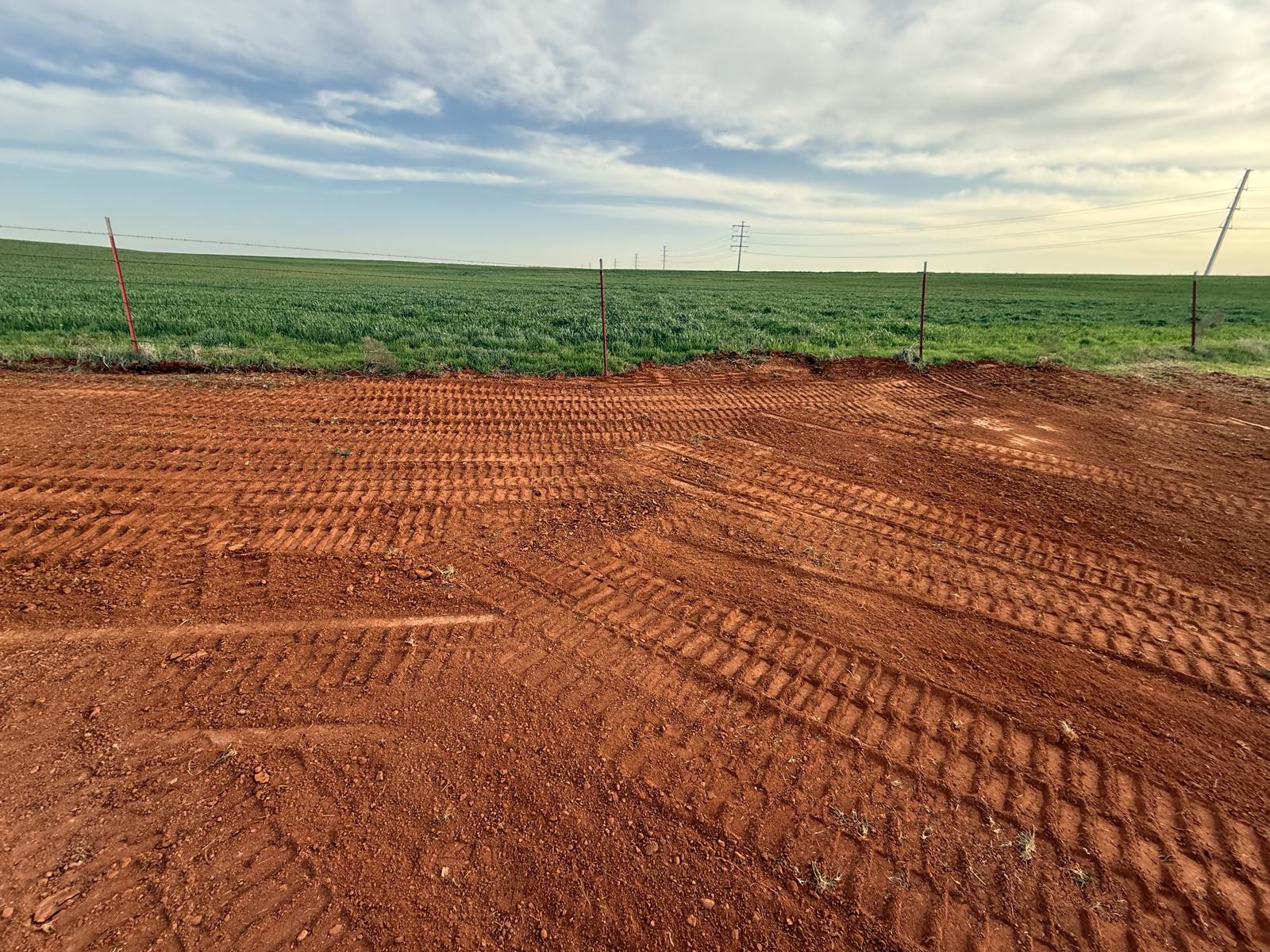
When we come out for grading and leveling work, we’re not just smoothing things out. We’re rebuilding the contour so water has a path. That might mean cutting a swale across the back yard, building up a low corner, or reshaping the whole lot if the original grade was bad to start with. On a typical quarter-acre lot in Edmond or Yukon, this is a one or two day job depending on how much dirt has to move.
French Drains and Surface Drains
Sometimes regrading alone isn’t enough — especially if you’ve got a low spot you can’t grade out, or a neighbor’s yard that drains into yours. That’s where a French drain comes in. Perforated pipe in a gravel trench, wrapped in fabric, sloped to daylight or to a pop-up emitter. Done right, it’ll pull water out of saturated ground and move it where you want it.
Surface drains (the round grates you see in low spots) work for collecting standing water fast, but they only work if the pipe has somewhere to go. We’ve pulled out plenty of drains in Moore and south OKC that were installed by handymen and dead-ended into nothing. Water has to exit somewhere.
Real drainage solutions are a system — intake, pipe, slope, outlet. Skip any one of those and you’ve wasted your money.
Building Up Around the Foundation
If your foundation has settled or the soil around it has eroded, you need fill dirt brought in and compacted properly. Not just dumped — compacted. Clay that isn’t compacted will settle again in one season. This is straightforward dirt work but it has to be done with the right material and the right equipment. A wheelbarrow and a tamper isn’t going to cut it for anything bigger than a small flower bed.
Driveway and Approach Fixes
A lot of rural and semi-rural properties around Guthrie, Cashion, and Kingfisher have gravel driveways that turn into rivers every spring. The fix is usually a combination of crowning the drive, adding culverts where needed, and making sure ditches on either side are actually flowing. We do a fair amount of this kind of work in the spring once the ground firms up enough to get equipment on it.
How to Tell What You’re Dealing With
If you’re trying to figure out whether you’ve got a small problem or a big one, walk the yard during the next decent rain. Bring boots. Watch where water comes from, where it goes, and where it stops. Take pictures. Look at:
Is water sitting against the foundation, or just in the yard?
Is it coming from your property or running in from a neighbor’s?
How long does it take to drain after the rain stops? Hours? Days?
Are there visible erosion channels?
That information saves time when you call somebody out. Searching “dirt work near me” will get you a list of contractors, but the more you can tell us about what’s actually happening, the better the estimate you’ll get.
When to Call Somebody
If you’re dealing with water in a crawlspace, water in a garage, or water that’s been standing for more than 48 hours after a storm, don’t wait. That’s the kind of thing that turns into foundation problems, mold, and structural damage. Cheap to fix in March. Expensive to fix in August after the slab cracks.
For yards that are just annoying — soggy in spots, slow to dry, hard to mow — you’ve got more time, but spring is still the right season to address it. Ground’s workable, you can see exactly where the water goes, and you’re ahead of summer when everything bakes hard.
We work all over the metro: Oklahoma City, Edmond, Yukon, Mustang, Piedmont, Moore, Deer Creek, El Reno, Guthrie, Cashion, and Kingfisher. Most drainage jobs are one to three days of actual work, depending on size and what’s involved. If you’ve been Googling “dirt work near me” trying to figure out who to call, we’d rather you call us before the next storm than after.
Get a Free Estimate
If your yard floods every spring and you’re tired of dealing with it, give 405 Dirt Services a call. We’ll come out, walk the property with you, tell you straight what it’ll take to fix, and give you a free estimate. No pressure, no upsell on stuff you don’t need. Just honest dirt work from people who’ve been doing it in central Oklahoma for years. Reach out today and let’s get your yard sorted out before the next round of storms hits.
