What Does a Dirt Pad for a Mobile Home Cost Near OKC, and How Thick Should It Be?
Setting a mobile home on raw Oklahoma dirt is asking for trouble. Our soil shifts, our clay swells when it rains and shrinks when it bakes, and a manufactured home that wasn’t set on a proper pad will tell you about it within a year — cracked drywall, sticking doors, sloping floors. A good dirt pad is cheap insurance compared to fixing a home that’s settled wrong.
If you’ve been searching for a dirt pad for mobile home near me around the OKC metro, here’s what you actually need to know about pricing, thickness, and what separates a pad that lasts from one that doesn’t.
What a Mobile Home Dirt Pad Actually Is
A dirt pad is a compacted, raised, level base of select fill that your mobile home sits on. It does three jobs:
Keeps the home above the surrounding grade so water runs away from it, not under it.
Provides a uniform, compacted surface so the piers or runners don’t settle unevenly.
Gives you a clean, stable working area for the set crew, utility hookups, and skirting.
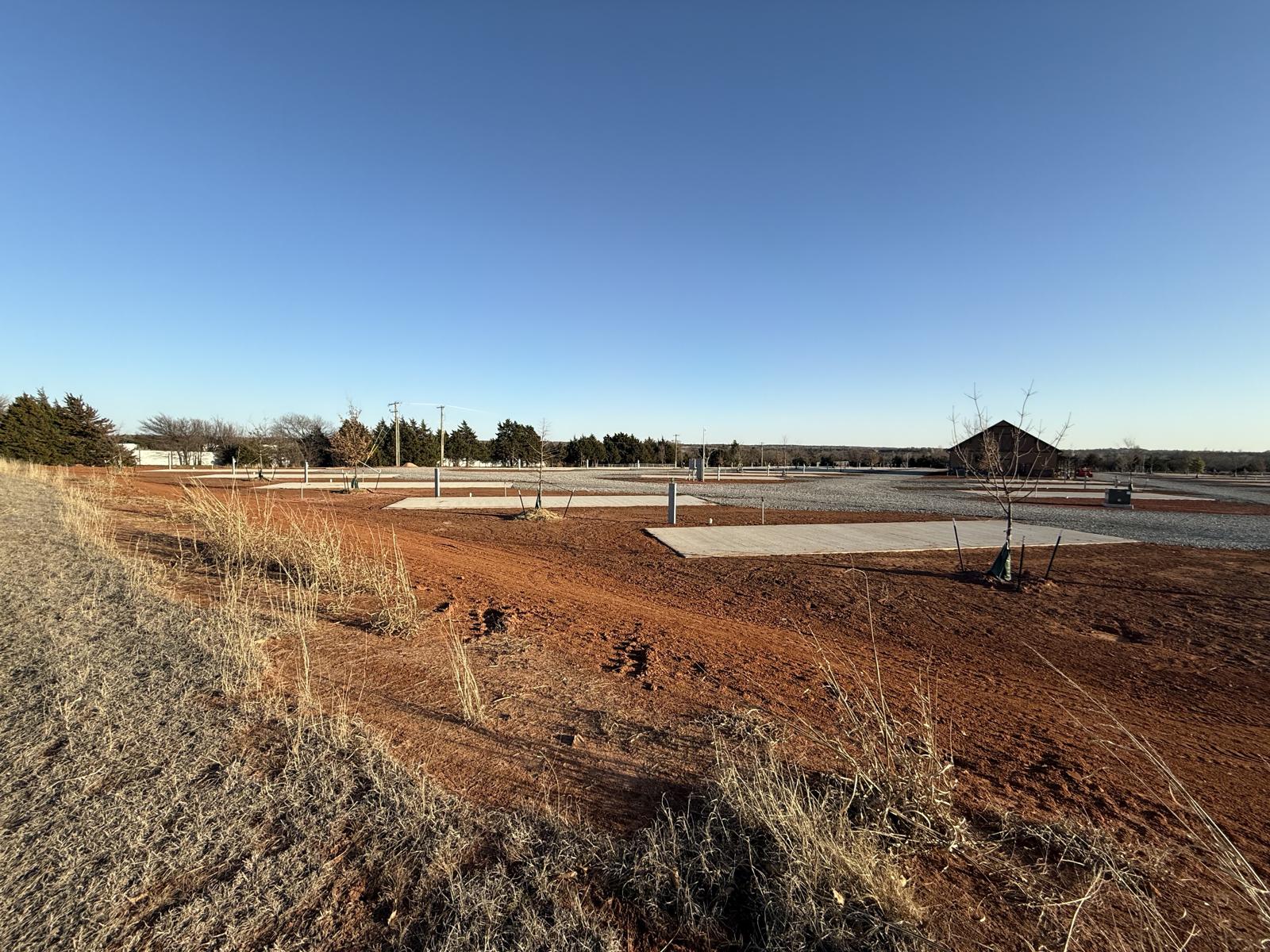
It’s not just a pile of dirt pushed flat with a tractor. A real pad is engineered fill — usually a clay or clay-loam blend — placed in lifts and compacted with a sheepsfoot or vibratory roller. Done right on the front end, it’ll outlast the home.
How Thick Should the Pad Be?
This is the question we get most often, and the answer depends on three things: your existing soil, the slope of the lot, and how high you need to be above the floodplain or surrounding grade.
Standard pad thickness
For most lots around Yukon, Mustang, Piedmont, and Deer Creek, we build pads in the 8 to 12 inch range of compacted fill above stripped, native soil. That’s after we’ve stripped the topsoil and any organic material — you never build a pad on top of grass, roots, or loose dirt.
When you need more
If the lot sits low, drains poorly, or sits in a flood-prone area (we see this around parts of El Reno, Cashion, and along creek bottoms in Kingfisher County), the pad might need to be 18 to 36 inches thick to get the home set high enough. We’ve built pads up to 4 feet tall when the customer needed to clear a flood elevation.
Width and length
The pad needs to extend at least 2 to 3 feet beyond the footprint of the home on all sides. That extra apron gives the perimeter compaction it needs and keeps the edges from sloughing off after the first hard rain. So a 16x80 single-wide needs a pad closer to 22x86 minimum.
What a Dirt Pad Costs Near OKC
Pricing varies more than people expect because every lot is different. But here are realistic numbers for the OKC metro as of current pricing:
Small pad (single-wide, 16x80)
For a basic pad on a lot that’s already mostly cleared and reasonably level — somewhere in Edmond, Moore, or northwest OKC — you’re typically looking at $3,500 to $6,500. That covers stripping, hauling in select fill, spreading, compacting in lifts, and final grade.
Standard pad (double-wide, 28x70 or similar)
A double-wide pad runs $5,500 to $9,500 in most cases. More dirt, more compaction passes, more time on the machine.
Larger or more complicated jobs
If we’re dealing with significant slope, heavy clearing, brush and tree removal, or hauling fill a long distance (rural lots in Guthrie, Cashion, or out past Kingfisher), pads can run $8,000 to $15,000+. A lot that needs Land Clearing before we can even start on the pad adds cost — but it’s cost you’d pay either way.
What drives the price up or down
Distance to fill source. Hauling clay 30 miles costs more than hauling it 5.
How much existing material we can use. Sometimes we can cut from a high spot on the lot and use it as fill. That saves real money.
Site access. If a tri-axle dump truck can pull right up, we move faster. If we’re shuttling with smaller trucks because of a narrow drive, that adds hours.
Drainage work. Some lots need a swale, a culvert, or basic Drainage Solutions to make the pad work long-term.
Removal of old structures or debris. Old slabs, stumps, or scrap from a previous home all have to go.
The Difference Between a $3,000 Pad and a $7,000 Pad
You can find someone with a tractor who’ll push some dirt around for $2,500. We’ve been called to fix plenty of those. Here’s what actually separates a cheap pad from one that holds up:
Stripping the topsoil
The top 4 to 8 inches of any Oklahoma lot is organic — grass, roots, soft soil. If you build on top of that, the organics rot, the pad drops, and your home goes with it. Every pad we build starts with stripping that material off and hauling it to a stockpile or off-site.
Using the right fill
Sandy loam doesn’t compact well. Pure topsoil is worthless as fill. We use select clay or clay-loam fill that compacts tight and sheds water. Around OKC, the right material is usually within a 10-mile haul.
Compacting in lifts
Dumping 18 inches of dirt and rolling the top doesn’t compact the bottom. We place fill in 6 to 8 inch lifts, compact each one, then add the next. It takes longer. It’s also why the pad still looks the same five years later.
Final grade and crown
The finished pad should have a slight crown — usually 2 to 3 inches higher in the middle than at the edges — so water runs off in every direction. A flat pad holds water. A crowned pad sheds it.
This is the same thinking that goes into proper Building Pad Construction for stick-built homes and shops. The principles don’t change just because it’s a manufactured home.
What Else You Might Need at the Same Time
While the equipment is on site, it’s almost always cheaper to knock out related work in the same trip:
Driveway. Most mobile home lots need a gravel drive. Doing it while we’re already there with trucks and a skid steer saves a separate mobilization. We do a lot of Gravel Driveways tied into pad jobs.
Septic pad and access. If you’re on septic, the lateral field area needs to be protected and accessible.
Utility trenching. Water, electric, and sewer trenches go in easier before the pad is finalized.
Culvert at the road. County right-of-way culverts are usually the homeowner’s responsibility.
Bundling these saves real money compared to bringing crews back out one at a time.
Timeline: How Long Does It Take?
Most single-wide and double-wide pads are a 2 to 4 day job once we’re on site, weather permitting. Add a day or two for clearing if the lot is wooded. Wet weather is the wild card — you can’t compact saturated clay, period. We’d rather wait a week than build a pad that’s going to fail.
Permits and Setbacks
Most rural lots in Canadian, Logan, and Kingfisher counties don’t require a permit for the pad itself, but the home setup will. Inside Oklahoma City, Edmond, or Mustang city limits, check with the local building department before you start. Setback requirements from property lines, septic systems, and easements all affect where the pad goes.
Get a Real Number for Your Lot
Every lot is different, and online estimators won’t get you close. If you want an honest price for a dirt pad for mobile home near me in the OKC area — Yukon, Piedmont, El Reno, Guthrie, or anywhere in between — the best thing to do is have us walk the property. Most pad estimates take 20 minutes on site, and we’ll tell you straight what it’ll take to do the job right.
Call 405 Dirt Services or request a free estimate through our site. We’ll come look at your lot, measure what’s there, and give you a written quote with no surprises. If you’re ready to set a home, we’re ready to build the pad under it.
