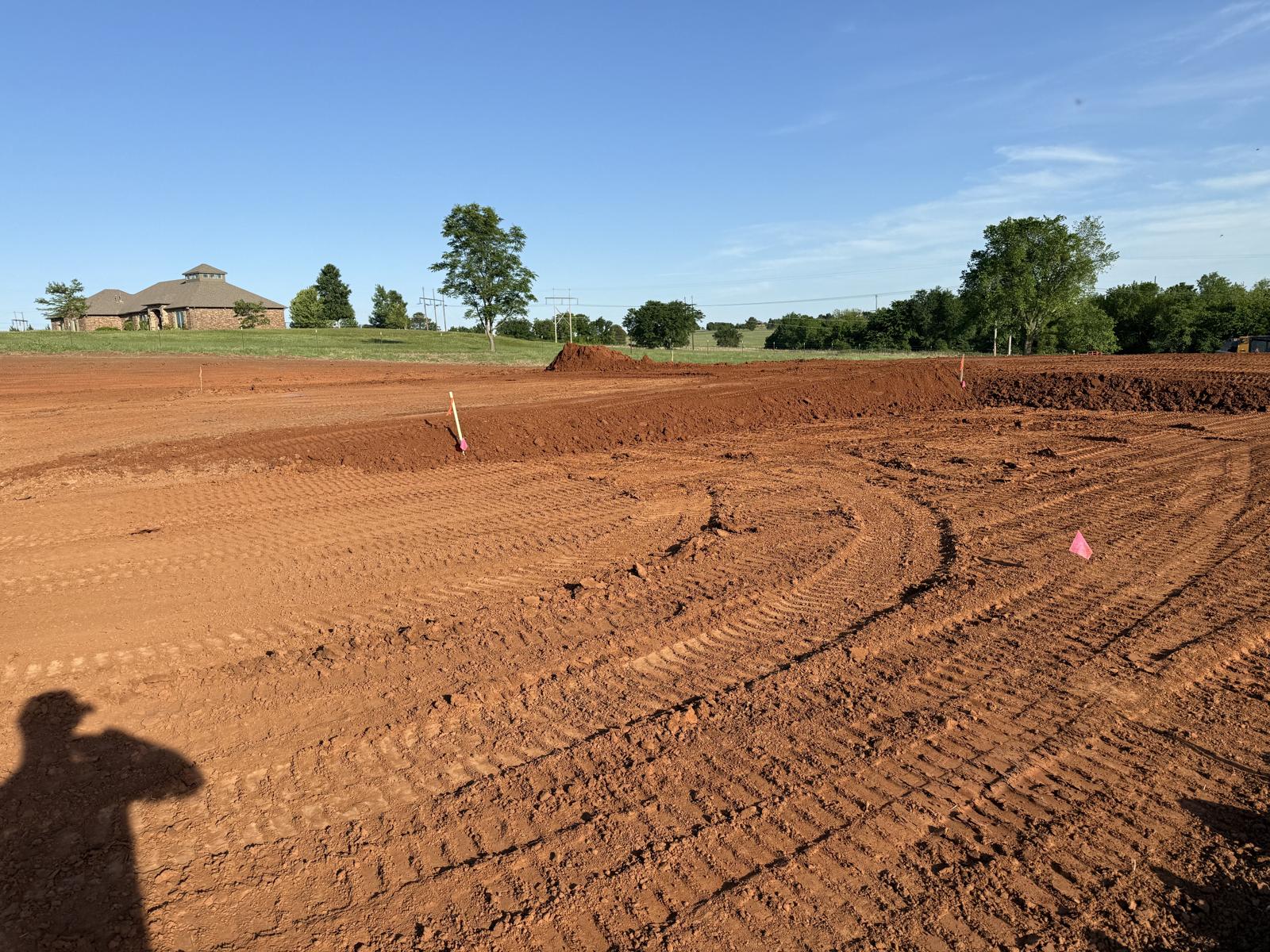
What Does a Dirt Pad for a Mobile Home Cost and How Long Does It Take?
If you’re putting a mobile home on land anywhere around central Oklahoma, the dirt pad is the part most people underestimate. It’s not just a pile of dirt. Done right, it keeps your home level, dry, and out of trouble with the county. Done wrong, you’re chasing settling cracks and standing water for the next ten years.
Here’s a straight breakdown of what a pad actually costs, how long it takes, and what goes into the price — based on the kind of work we do every week across Oklahoma City, Yukon, Piedmont, and the surrounding metro.
What a Mobile Home Dirt Pad Actually Is
A dirt pad is a compacted, level building surface raised above the surrounding grade. For a mobile home, it does three jobs:
- Gives you a flat, stable base so the home sits level and the frame doesn’t twist.
- Raises the home above the surrounding ground so water runs away from it, not under it.
- Provides enough room around the perimeter to set anchors, run utilities, and skirt the home.
A typical single-wide pad runs around 16x80 feet with a couple of feet of working room on each side. A double-wide is closer to 32x80. Most pads we build end up between 1,500 and 3,000 square feet of finished surface, depending on the home and how much driveway or turnaround you want tied in.
What Does a Dirt Pad for a Mobile Home Cost?
If you’ve been searching for a dirt pad for mobile home near me, you’ve probably seen prices all over the map. Here’s why.
For most jobs in the OKC metro, expect somewhere between $3,500 and $12,000 for a finished pad. That’s a wide range, and it’s wide for real reasons:
Pad Size and Height
A 12-inch-tall pad for a single-wide on flat ground in Mustang is a different animal than a 30-inch pad for a double-wide on a sloped lot in Edmond. Every extra inch of height across a 2,000+ square foot footprint adds dirt — and dirt costs money to haul, place, and compact.
Where the Dirt Comes From
If we can cut and fill on-site — meaning we shave down a high spot to fill a low spot — you save money. If the lot is already flat or low, we’re trucking in select fill from a pit. Around Oklahoma City and Kingfisher County, hauled fill typically runs $8–$15 per cubic yard delivered, and a pad can need 100–400 yards.
Soil Conditions
Red clay, sandy loam, and the rocky stuff you find west of El Reno all behave differently. Clay holds water and needs proper compaction in lifts. Sandy soil drains well but needs more material to stay put. If we hit rock or have to dig out soft spots, that adds time.
Site Access
A wide-open pasture in Cashion is easy. A wooded lot in Piedmont with a narrow driveway and a fence to work around takes longer and sometimes needs Land Clearing before we can even start moving dirt.
Drainage Work
If the lot doesn’t shed water naturally, we’ll cut swales, build up the pad higher, or install culverts. On lots near creeks or in flatter parts of Moore and south OKC, this is where Drainage Solutions get added to the scope.
Driveway and Tie-Ins
A lot of customers add a gravel approach at the same time. It’s cheaper to do it while the equipment is already on-site than to bring everything back later.
A Realistic Price Breakdown
Here’s roughly how the money typically splits on a standard double-wide pad:
- Site prep and clearing: $500–$2,500
- Cut, fill, and hauled material: $2,000–$6,000
- Compaction and grading: $800–$2,000
- Final shaping and cleanup: $300–$700
- Drainage features (if needed): $500–$2,500
For a basic single-wide on a clean, flat lot in Yukon or Mustang, you can sometimes come in under $4,500. For a double-wide on a tougher lot in Guthrie or Deer Creek with hauled fill and drainage, $9,000–$12,000 is realistic.
How Long Does It Take to Build a Mobile Home Pad?
Most pads we build take 2 to 5 working days on-site once we start. Here’s how that usually breaks down:
Day 1 — Clearing and Stripping
We strip the topsoil and any vegetation off the building footprint. Topsoil is organic material — it’ll rot and settle under your home, so it has to come off. If the lot needs trees, brush, or old structures removed, this is when Site Preparation happens. On a wooded lot this step alone can take an extra day or two.
Day 2–3 — Building the Pad
This is the dirt work. We bring in or move fill in 6–8 inch lifts and compact each one before adding the next. Skipping this step is how you end up with a sinking corner two years later. For larger pads or when we’re hauling material from off-site, this stretches into a third day.
Day 4 — Grading and Shaping
Final grading gets the pad flat to within an inch or so across its surface, with the right slope around the edges so water drains away. This is also when we shape the surrounding ground to tie in cleanly.
Day 5 — Driveway, Cleanup, Final Walk
If gravel goes in, it goes in now. We clean up tracks, dress the perimeter, and walk it with the customer.
Weather is the wild card. Oklahoma red clay turns to soup after a hard rain, and you can’t compact mud. If we get two inches of rain, plan on losing 2–3 days waiting for the lot to dry enough to work.
Permits and County Requirements
Most counties around the metro — Oklahoma, Canadian, Logan, Kingfisher — have minimum pad height requirements, especially in flood-prone areas. Some require the finished pad to be a certain elevation above the road or above the surrounding grade. Before we break ground, it’s worth a quick call to your county to confirm. We can usually tell you what’s typical based on where your lot sits.
What Separates a Good Pad From a Bad One
A few things to ask any contractor before you sign:
- Are you stripping the topsoil first? If the answer is no, walk away.
- Are you compacting in lifts? A pad dumped and shaped in one pass will settle unevenly.
- What kind of fill are you using? Select fill or sandy clay loam compacts well. Black dirt and trash fill don’t.
- How much slope are you putting on it? You want water moving off the pad, not pooling on it.
This is the kind of Building Pad Construction work that pays off for the life of the home. Cutting corners here is the most expensive thing you can do, because fixing a bad pad after the home is set means jacking, leveling, and sometimes pulling the home off entirely.
Getting an Accurate Quote
Square-footage estimates only get you so far. To give you a real number, we need to see the lot — how it sits, what the soil looks like, where water runs, and how much access we have. Most quotes take us 15–20 minutes on-site.
If you’re shopping for a mobile home dirt pad anywhere from Edmond down to Moore, or out west toward El Reno and Kingfisher, we can usually get out within a few days to take a look.
Ready to Get Started?
If you’ve got a lot and a mobile home on the way — or you’re still planning and want to know what your site is going to need — give 405 Dirt Services a call. We’ll walk the property, talk through your options honestly, and put together a free estimate with real numbers, not ballpark guesses. No pressure, no upsell. Just straight answers from people who do this work every day across the OKC metro.
