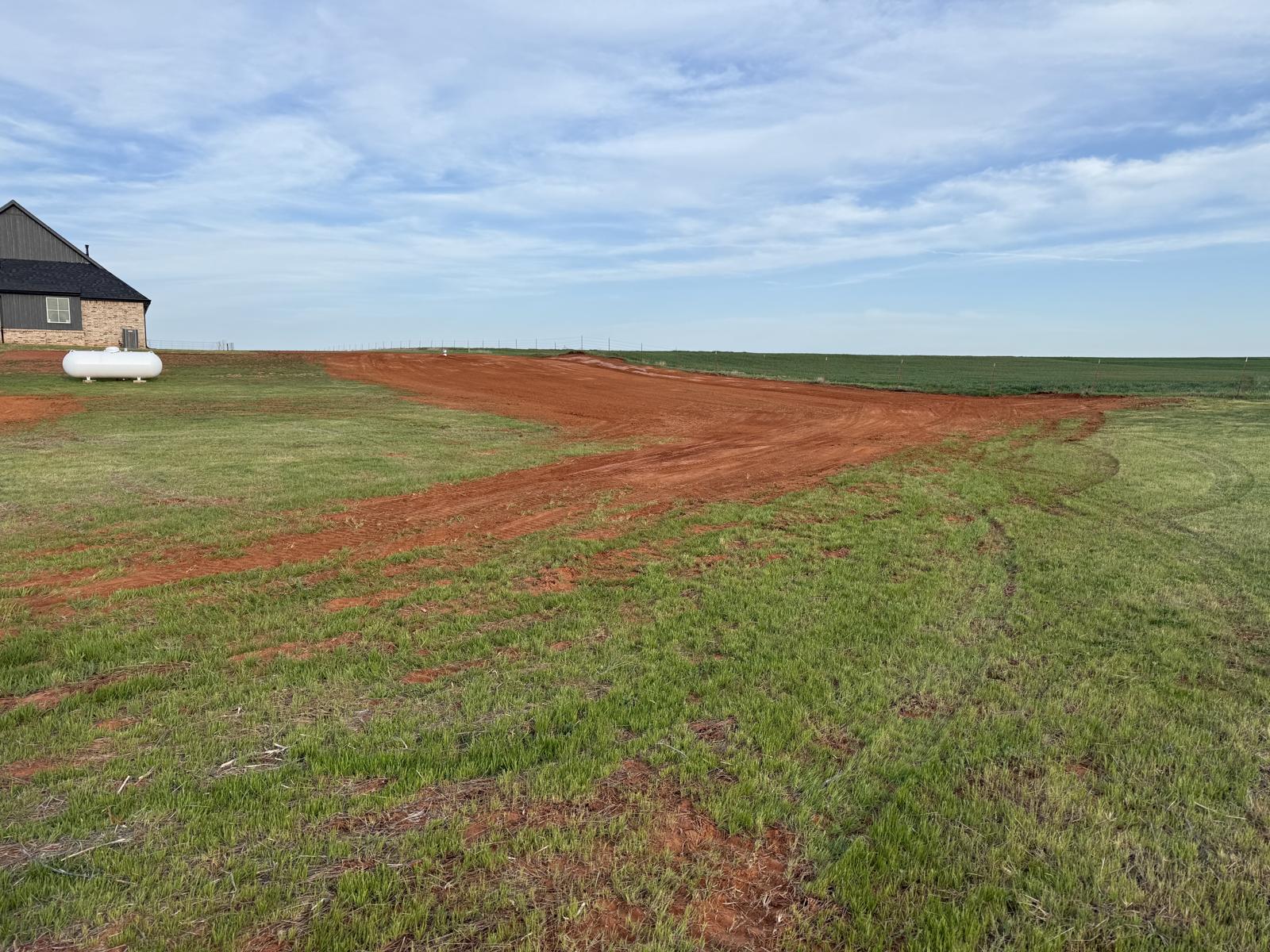
How to Prep a Building Pad in Edmond, OK Before July Heat Cracks the Soil
If you’ve built anything in central Oklahoma, you already know what July does to our dirt. The clay shrinks, cracks open wide enough to lose a tape measure in, and any pad that wasn’t built right starts telling on itself. Foundations shift. Slabs crack. Garages settle on one corner. By the time you see it, the fix costs more than the original pad did.
Edmond sits on some of the most stubborn clay soil in the metro. It swells when wet, shrinks when dry, and doesn’t forgive shortcuts. If you’re planning a shop, a barndominium, a home addition, or any kind of slab work this summer, the prep you do before the heat hits is what determines whether your structure stays level for 30 years or starts cracking by Christmas.
Here’s how we approach building pad construction in Edmond, OK and what you need to know before the ground gets brick-hard.
Why Edmond Soil Is Different
Drive 20 minutes in any direction and the dirt changes. Out toward Piedmont and Cashion you start hitting sandier loam. Down in Moore and parts of south OKC, you get more uniform red clay. But Edmond — especially north and east of I-35 toward Deer Creek and Arcadia — has a heavy expansive clay layer that moves with moisture.
That movement is the problem. When clay dries out in July and August, it can shrink 4-6% by volume. That doesn’t sound like much until you realize a 40x60 pad can heave or settle over an inch in spots. Concrete doesn’t bend. So it cracks.
The fix isn’t magic. It’s process. You build the pad to handle the movement instead of fighting it.
Start With the Site, Not the Pad
Before any dirt gets pushed, walk the site. I tell every homeowner the same thing: where does water go when it rains hard? In Edmond, we get those May and June downpours that drop two inches in 40 minutes. If your pad sits in the path of that runoff, you’ve got a problem before you start.
Things to look at:
Slope direction. Water needs to move away from the pad on all four sides. Minimum 2% fall for the first 10 feet.
Trees and roots. Big oaks and elms within 20 feet of a pad will pull moisture out of the soil unevenly. That’s a recipe for differential settling.
Existing fill. A lot of lots in newer Edmond developments — especially around Coffee Creek and out by Arcadia Lake — were rough-graded years ago with whatever fill was handy. You can’t trust it. Test it or cut it out.
If the lot needs serious cleanup before you can even think about a pad, that’s a Land Clearing and Site Preparation job. Don’t try to build a pad on top of a half-cleared lot. You’ll regret it.
Strip the Topsoil. All of It.
This is where most DIY pads fail. Topsoil is full of organic material — roots, grass, decomposing stuff. It compresses unevenly and rots out over time. Anything you build on top of it is going to settle.
Strip a minimum of 6 inches. On lots with heavy vegetation or old garden areas, we’ll go 8-12 inches until we hit clean subgrade. Stockpile that topsoil somewhere out of the way — you’ll want it later for finish grading around the structure.
Once you’re down to subgrade, look at what you’ve got. If it’s solid red clay, good. If it’s soft, wet, or full of debris, you’ve got more work to do.
Build the Pad in Lifts
A proper pad isn’t just a pile of dirt. It’s compacted layers — what we call lifts. Each lift is 6-8 inches of select fill, compacted with a sheepsfoot or smooth drum roller before the next lift goes on.
Skip this step and you’re building on a sponge. The dirt will settle on its own timeline, usually 6-18 months after construction, and your slab goes with it.
For most residential pads in the Edmond area, we use a structural fill — clean clay or a clay-sand mix, depending on what the soil report calls for. Moisture matters. Too dry and it won’t compact. Too wet and it pumps under the roller. In July, dry is the bigger fight, and you’ll be running a water truck to keep the fill at optimum moisture.
A 95% standard Proctor compaction is the target. If you’re building anything that’ll get permitted and inspected — shops over a certain size, additions, anything commercial — you’ll need density tests to prove it.
Oversize the Pad
One thing I see homeowners cut corners on: they want the pad exactly the size of the building. Don’t do that.
Build the pad at least 2 feet wider than the structure on all sides. Three feet is better. That extra footprint gives you:
A working surface for the slab crew
Room for the slab edge to bear on properly compacted fill
Drainage shoulder so water doesn’t pond against the foundation
This isn’t upselling. It’s basic Building Pad Construction practice, and skimping on it is the cheapest way to ruin an expensive building.
Drainage Is Not Optional
I’ll say it plain: in Edmond clay, drainage is half the job. Water that sits next to or under your pad will find the weakest point and wreck it.
What good drainage looks like on a pad site:
Surface Drainage
The pad should be the high point. Ground slopes away in every direction. No swales feeding toward it, no low spots where water collects after a storm.
Subsurface Drainage
On sites with high water tables or persistent wet spots — we see this a lot near creek bottoms in Yukon and Mustang — you may need a French drain or perimeter drain tied into daylight or a sump.
Gutter Planning
Plan now for where roof runoff will go. A 2,000 sq ft roof dumps a lot of water in a heavy rain. That can’t just spill onto the pad edge.
If your site has standing water issues, get those handled first with proper Drainage Solutions before pouring a dime into pad work.
Time It Right
Here’s the part most people don’t think about. The window for good pad work in central Oklahoma is tighter than people realize.
March-May: Wet. Hard to compact. You’ll get rained out.
June: Usually the sweet spot. Dry enough to work, not yet hammering hot.
July-August: Workable but brutal. Soil dries out fast, you’re watering constantly, crews slow down in the heat.
September-October: Good window if you can get on the schedule.
November-February: Freeze/thaw plays games with compaction.
If you want a pad ready for a slab pour in late summer, you need dirt work happening in May or June. Wait until July and you’re fighting the calendar and the soil.
What It Costs and What It’s Worth
I won’t quote numbers in a blog post because every site is different. A flat lot in a Deer Creek subdivision is a totally different job than a sloped acreage out toward Guthrie or Kingfisher with trees and a creek to deal with.
What I will say: a properly built pad is the cheapest insurance you’ll buy on a building. Cutting $2,000 off the pad to save money, then spending $15,000 fixing a cracked slab three years later, is a bad trade. We’ve been called out to too many of those repairs.
Get the Pad Right the First Time
405 Dirt Services builds pads across the metro — Edmond, OKC, Yukon, Piedmont, Mustang, Moore, El Reno, Guthrie, and out into Cashion and Kingfisher. We run our own equipment, do our own Grading and Leveling, and we’ll tell you straight what your site needs and what it doesn’t.
If you’ve got a build coming up this summer or fall, now’s the time to get on the schedule. Call or message us for a free site visit and quote. We’ll walk the lot, talk through your plans, and give you a real number — no surprises, no upsell. Reach out today and let’s get your pad built right before the July heat starts cracking the ground open.
