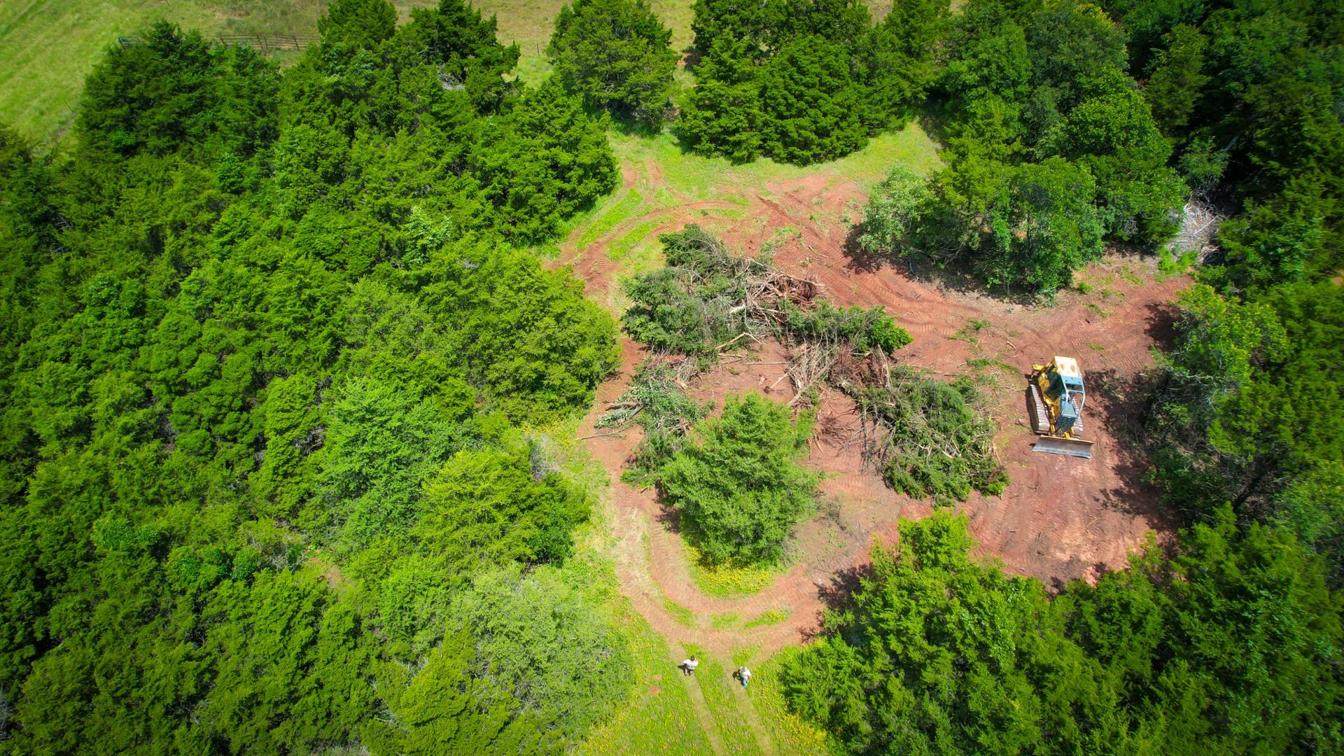
Building Pad Construction in Edmond: What It Costs, How Long It Takes, and What Can Go Wrong
If you’re building a house, shop, or barndominium in Edmond, the pad is where everything starts. Get it wrong and you’ll be chasing cracks, settling, and drainage problems for the life of the structure. Get it right and you won’t think about it again.
We do a lot of building pad construction around Edmond, Deer Creek, and north OKC, and the questions we hear most are always the same: what does it cost, how long does it take, and what can go sideways? Here’s the straight answer on all three.
What a Building Pad Actually Is
A building pad is the engineered dirt platform your slab, footings, or post-frame building sits on. It’s not just “flat dirt.” A real pad is built up in compacted lifts of suitable fill, shaped with the right elevation and slope, and sized with enough overdig past the building footprint so the edges don’t blow out during construction.
On a typical Edmond homesite, that means stripping off topsoil and organics, bringing in or re-using suitable select fill, compacting it in 6- to 8-inch lifts, and finishing to grade within a tight tolerance — usually plus or minus a tenth of a foot across the pad.
Skip any of those steps and you’re building on a problem.
What Building Pad Construction Costs in Edmond
Nobody can give you a real number without seeing the lot, but here’s how pricing actually shakes out for building pad construction in Edmond OK.
Small residential pad (house or shop, 2,000–3,500 sq ft)
On a relatively flat lot with decent native soil and no major clearing, you’re typically looking at $3,500 to $8,500 for the pad itself. That assumes minimal import fill and a reasonable haul distance.
Mid-size pad with moderate fill or site work
Sloped lots in places like Arcadia, east Edmond, or out toward Coffee Creek often need 2–4 feet of built-up fill on the low side. Once you’re importing dirt, running a bigger crew, and spending more time on compaction, pads commonly run $8,000 to $20,000.
Large or difficult sites
Heavy tree cover, rock, wet areas, or a pad that needs significant cut-and-fill balancing can push the number past $25,000. Acreages around Piedmont, Guthrie, and Cashion where we’re doing land clearing plus pad work in one shot tend to land in this range.
What drives the price
Import fill. Trucked-in select fill is the single biggest cost swing. If your lot has usable material on-site, you save thousands.
Haul-off. If we’re cutting down a high spot, that dirt has to go somewhere.
Access. A tight lot in an established Edmond neighborhood takes longer than a wide-open 5-acre tract in Kingfisher.
Compaction testing. If your builder or lender requires density tests from a geotech, budget $500–$1,500 extra.
Soil conditions. Edmond has pockets of red clay that move with moisture, and the closer you get to the Deep Fork and Cottonwood Creek drainages, the more likely you’ll hit soft spots.
How Long It Takes
Most people overestimate how long pad work takes and underestimate how much weather matters.
Typical timelines
Simple residential pad: 1–3 working days
Pad with clearing and grubbing: 3–6 working days
Acreage pad with significant fill, drainage, and driveway: 1–2 weeks
That’s active work time. Calendar time is a different animal. Oklahoma weather will add days. A hard rain on red clay means you’re waiting 2–5 days before you can get back on it without pumping moisture into the lifts and ruining your compaction. Plan around that instead of fighting it.
What speeds things up
Having utilities located before we show up
Knowing your finished floor elevation from the builder
Clear access for dump trucks
A decision on what happens to cleared trees and brush (burn, haul, grind)
What slows things down
Waiting on a surveyor to set corners and FFE
HOA or city of Edmond permit issues
Discovering old septic, buried debris, or an abandoned well mid-job
Wet weather during the compaction phase
What Can Go Wrong (And How to Avoid It)
This is the part most contractors won’t tell you. Pads fail, and when they do, it’s almost always one of these reasons.
1. Organics left under the pad
If topsoil, roots, or old stumps get buried under fill, they rot. Rotting material leaves voids, and voids turn into slab cracks and settling 2–5 years after you move in. Every pad should start with a proper strip and grub — not a quick blade pass.
2. Fill placed too thick
Dirt has to be compacted in lifts. Dump a three-foot pile, run a sheepsfoot over the top, and the bottom two feet are basically loose. We’ve come behind other outfits in Yukon and Mustang to fix pads that looked fine on day one and sank six inches in the first wet season.
3. No drainage plan
A perfect pad on a lot that sheds water toward the house is still a disaster. Edmond lots with any kind of slope need drainage solutions worked into the pad plan — swales, daylight drains, or positive grade away from the structure on all four sides. This gets missed constantly.
4. Wrong fill material
Not all dirt is pad dirt. Fat clay, high-organic topsoil, or debris-laced fill from a random source will move on you. Select fill with the right plasticity index is what goes in a pad, period.
5. Pad too small
Your pad needs to extend past the building footprint — typically 3 to 5 feet on all sides, more if you’ve got a slope. Build it to the exact footprint and the edges will slough off before the foundation guys ever show up.
6. Ignoring the builder’s specs
Some builders want a stem-wall-ready pad with specific over-dig. Others want slab-ready with a gravel cap. Some engineers spec moisture conditioning. If nobody’s talking to the builder before the dozer shows up, you’re guessing.
How We Approach Pads in Edmond
Our process is boring on purpose. Boring means no surprises.
Walk the lot with you, the builder, or both.
Confirm finished floor elevation and pad dimensions in writing.
Handle any site preparation — clearing, demo, stripping topsoil, hauling debris.
Cut, fill, and compact in proper lifts with the right equipment for the size of the job.
Shape to grade, verify elevations, and leave the site ready for the foundation crew.
Address drainage before we leave, not after.
We run this same process whether it’s a custom home pad in Deer Creek, a shop pad in Piedmont, or a barndominium site out near El Reno or Cashion.
Get a Real Number for Your Lot
Ballpark pricing is useful for planning, but the only number that matters is the one tied to your specific lot. If you’re planning a build in Edmond, Oklahoma City, Yukon, Mustang, Moore, Piedmont, Guthrie, or anywhere else in the 405, give us a call or send us the address and the building size. We’ll come out, walk it, and give you a straight quote with no fluff. Contact 405 Dirt Services for a free estimate on your building pad — we’ll tell you what it’ll cost, how long it’ll take, and what to watch for on your specific site.
